
LA Park History Series: LA Freeways and Their Encroachment on Hollenbeck Park
Series written by Kate Martin Rowe
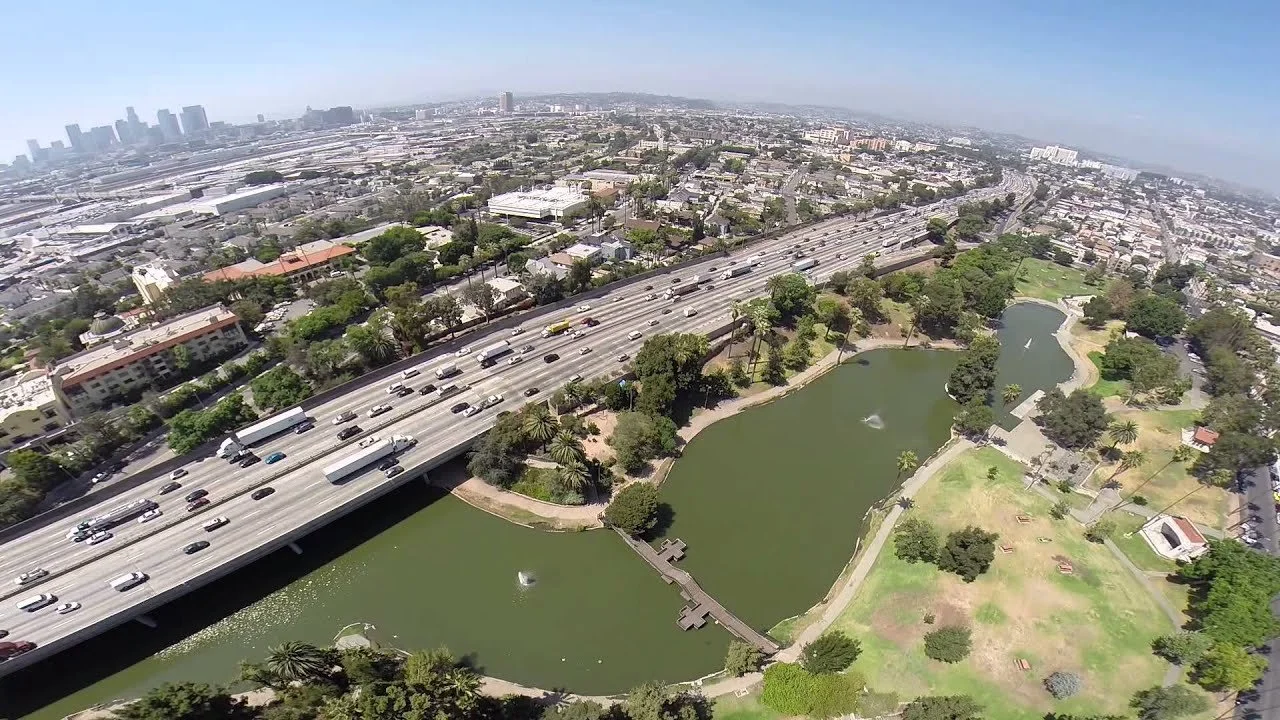
Hollenbeck Park today. Photo courtesy of EastsiderLA
It Was Known as One of LA's Most Beautiful Parks.
The history of freeways in Los Angeles is an ugly one. Building them has often meant the displacement of Black and brown communities. News reports utilize the language of violence in their attempts to describe it: neighborhoods are destroyed, sliced, filleted, denuded, bulldozed, torn through, torn down, and demolished. And yet, even this doesn’t capture the bizarre solution that city planners in 1960 devised for Boyle Heights’s Hollenbeck Park when they decided it stood in the way of expanding the 5 Freeway.
When the park was dedicated in 1893, Hollenbeck stood out as one of L.A.’s most impressive and picturesque with 21 acres of artificial lakes and islands, big trees, and fountains. The freeway reduced the park to a mere four acres and now runs right overhead, cutting the park in half and polluting the space with exhaust and noise. It’s not just the 5. The 10, 60, and 101 Freeways all cut through the community of Boyle Heights, and unfortunately, this is not an isolated L.A. story.
The disproportionate impact of freeways is by design, as Matthew Fleischer explains in the LA Times. Freeway planning in the 1940s was intended to end the “casual mingling of the races” that the Red Car public transit system had fostered. Before the arrival of freeways, a diverse community flourished in Boyle Heights in the early 20th century. Mexicans, Jews, Irish, Italians, Japanese, and African Americans lived and worked as neighbors. Freeways were also rerouted to destroy affluent Black neighborhoods like Sugar Hill, which had become a center of Black culture in the 1940s, attracting Black actors, business moguls, comedians, musicians, and producers.
Freeway displacement has been devastating to communities all over L.A. In Boyle Heights alone, 15,000 low-income residents have been displaced and 2,000 homes destroyed by freeway construction. The interchange of the 5, 10, 60, and 101 that slice up Hollenbeck Park now serves as the largest and busiest interchange in the nation with an estimated 2.4 million cars traveling its corridors every day. Boyle Heights earns a pollution burden score of 100%, the highest given by CalEnviroScreen. Freeways often block access to parks and local streets, and the health effects of freeway-adjacent living have been widely documented. The CDC has linked childhood obesity, diabetes, asthma, and mental health challenges with the lack of park access.
Communities of color were ignored, Fleischer writes, when they fought the building of freeways in their neighborhoods. Instead, planners diverted freeway projects from predominantly white spaces like Beverly Hills and South Pasadena. These freeways quickly became overcrowded, and the same communities who had endured the brunt of pollution, congestion, and freeway noise faced pressure to expand them.
Groups like East Yard Communities for Environmental Justice (EYCEJ) have spent years fighting for clean air, green space, and transit corridors that enhance quality of life rather than destroy it. Neighborhood residents have also advocated for park space instead of freeways. El Sereno’s Arroyo Playground was launched by the Concerned Neighbors of El Sereno and other advocates who believed so fervently in children’s right to outdoor space that they stuck with the project throughout the seven years it took to get it built. The park was eventually built on a Caltrans right of way for a portion of the 710 freeway that never got built. Many homes had been demolished and the lot had sat vacant for 50 years until neighbors organized for the park.
Architecture critic Christopher Hawthorne envisions a future where freeways are re-purposed for human-centered transit, including public transportation, bike routes, and electric cars, as well as parks. The Coalition for Environmental Health and Justice recently demanded that transportation agencies use the expansion of the 710 Freeway to develop a zero-emissions corridor that provides alternatives to driving, and more park space, while ensuring that community members are not displaced. The City of Long Beach is working on a project to replace a mile of the Terminal Island Freeway with a park.
This is the future that LANLT is committed to as well: a city in which transportation corridors serve all of our residents, where freeways connect us in creative ways to each other and green space, and where these systems enhance our collective health and wellbeing.
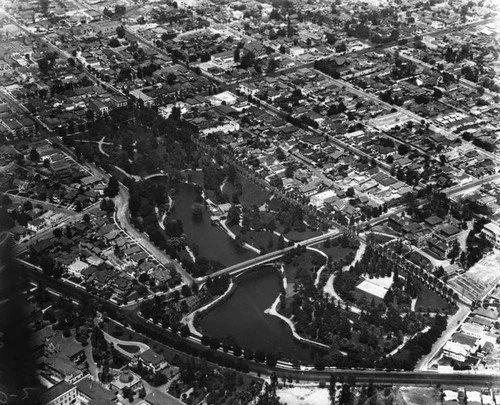
Hollenbeck Park in 1924 from the Security Pacific National Bank collection in the LA Public Library.