
LA Park History Series: Elysian Park and Chavez Ravine: Another L.A. Displacement
Series written by Kate Martin Rowe

A 1959 LA Times photo of the groundbreaking ceremony for what would become Dodger Stadium shows a crowd of 3,000 onlookers. Four bulldozers dot the hill like giant bulls kicking up dust. The crowd appears to be full of eager supporters welcoming L.A.’s first major sports team to town, but perhaps some of them were former residents of the Chavez Ravine.
Did they see it as the final act of violence that buried any remaining evidence of the vibrant community they’d lost—the houses they’d built, the vegetables they’d planted, or the games their children had played?
Beginning in the early 1900s, people began settling in Chavez Ravine, most of them Mexican-American. It would become home to 300 families and consisted of three distinct neighborhoods: Palo Verde, La Loma and Bishop. The Zinn Education Project explains that although outsiders labelled the community as a slum, for the people who lived there it was a small, rural paradise in the middle of a booming metropolis. People didn’t lock their doors, neighbors helped each other and children roamed freely. It boasted its own churches, schools and grocery store. Many residents owned their own homes. Chavez Ravine was one of the few places Latinx families could own property in L.A. due to pervasive red-lining policies.
Elysian Park was adjacent to Chavez Ravine and formed a buffer zone of open space between them and the city. Elysian Park had been set aside as park land by the City of L.A. back in 1886. Prior to that, the 550 rugged acres that made up Elysian Park were too steep for development, and the city had been unable to sell the property. As a park, however, it eventually became the site of tree plantings, a city arboretum, carriage rides, a shooting range for the L.A. Police Academy, and in 1936, home to an extension of Figueroa Street, which would become the 110 Freeway. To the children of Chavez Ravine, Elysian Park was their backyard.
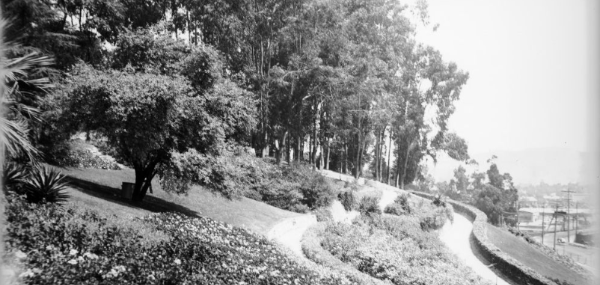
Elysian Park hillside in early 1900s. Denver Public Library.
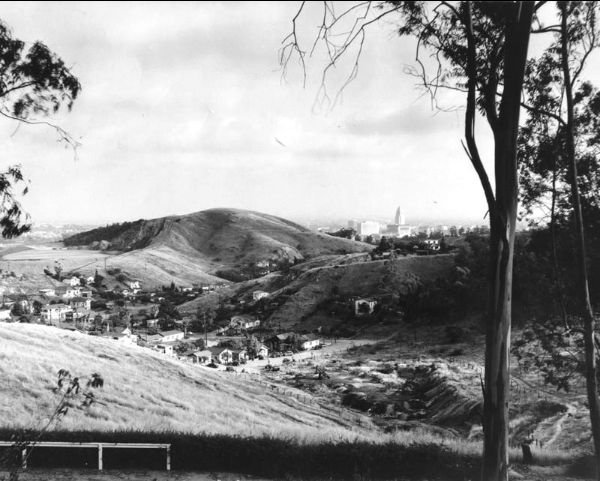
Life in Chavez Ravine, 1952. Housing Authority Collection: Leonard Nadel, photographer.
Chavez Ravine’s erasure was set in motion when in the Federal Housing Act of 1949 began awarding federal grants to cities for new public housing projects. Then LA Mayor Fletcher Bowron approved a project that would place 1,000 new housing units on Chavez Ravine and adjacent land. In the early 1950s, the city began talking up the new development, promising playgrounds, schools and affordable housing to residents. Anyone displaced by the development would receive priority housing in the new development, the city said, and it offered cash for their land, though at very low prices. Those who refused were offered increasingly lower sums, or their property was seized by eminent domain. By 1953, the city had seized or purchased a majority of the properties.
“Red scare” politics of the 1950s also came to play a part in this story. Business interests who wanted Chavez Ravine for their own purposes began characterizing public housing as a socialist scheme. Mayor Norris Paulson won his election in 1953, by exploiting these fears over communism and public housing and running on a promise to buy back Chavez Ravine from the federal government, which is what he did, with the caveat he would develop it for the public good.
Despite all this, some Chavez Ravine families held on to their land for years and refused to sell. On May 11, 1959, a day that became known as Black Friday to the displaced, the handful of families that remained in Chavez Ravine were forcefully kicked out. Newspaper photos documented the outrages of that day:
Aurora Vargas being carried out by L.A. Sheriff’s deputies,
Members of the Angustian family searching for personal belongings in the rubble, and
Avrana Arechiga and her family camping out after their property was bulldozed.
The public housing, parks and schools, of course, never materialized. Soon after, the city negotiated a deal to sell Chavez Ravine to the owner of the Brooklyn Dodgers Walter O’Malley for a fraction of its worth. O’Malley, in return, promised to build a baseball stadium on the land. An uproar ensued with many questioning whether baseball constituted a public good. But in a June 1958 referendum, the stadium deal passed by less than 25,000 votes.
On April 10, 1962, just three years after the last families were evicted from Chavez Ravine, Dodger Stadium celebrated opening day.
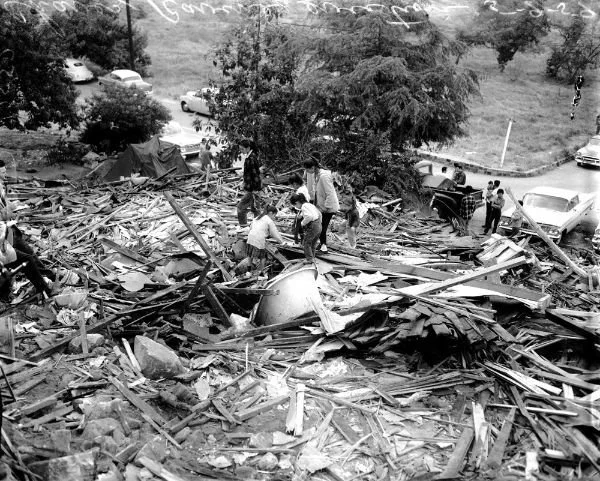
Bulldozers destroy the remaining homes in Chavez Ravine 1959. USC Libraries, Special Collections.
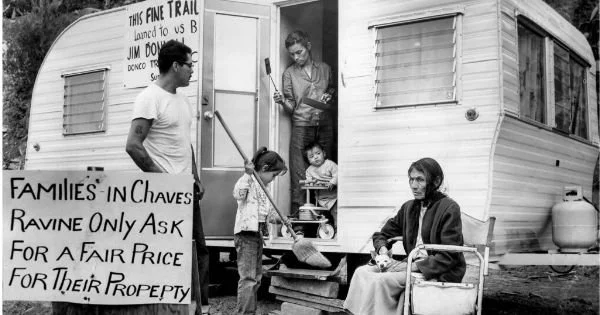
After bulldozers destroyed their Chavez Ravine home, Victoria Angustian stands in the doorway of her family’s trailer on May 13, 1959. (John Malmin / Los Angeles Times)
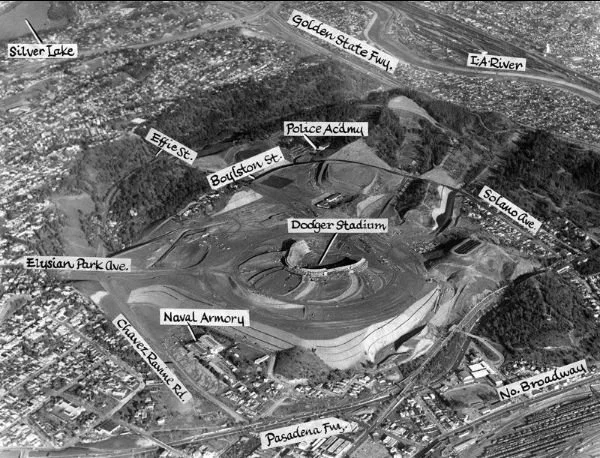
Dodger Stadium Construction. (Image via Pinterest)
Today, Elysian Park is still home to Dodger Stadium, as well as the L.A. Police Academy, Barlow Respiratory Hospital, Leo Politi Park, the Chavez Ravine Arboretum, a recreation center, playgrounds, BBQ pits and miles of hiking trails. There, you can also find a memorial to Louis H. Santillan, who was president and founder of Los Desterrados, a group of displaced Chavez Ravine residents and their descendants who still meet in Elysian Park every July for a picnic.
We at LANLT want to acknowledge that Elysian Park, though one of L.A.’s most beloved, beautiful and iconic open spaces, also witnessed a forced displacement that forever altered a community and their descendants. It’s critical to remember this tragic history while also working to recognize and expand the importance of parks in our city life.
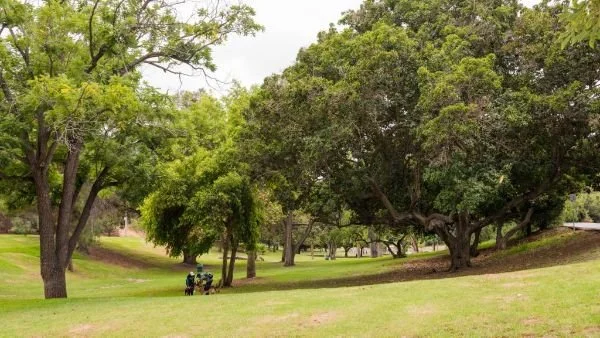
Chavez Ravine Arboretum at Elysian Park today. Photo via LA Parks Foundation